


Edited by Ruoqi Lin.
June 13, 2026
Last updated: June 17, 2026
What Health Testing Should a Responsible Maine Coon Breeder Actually Do?
When families begin searching for a Maine Coon kitten, they often see the phrase “health-tested parents.”
But what does that actually mean?
A basic DNA panel is a good starting point, but it is not the whole picture. Maine Coons are a large, slow-maturing breed, and some important health concerns cannot be ruled out by DNA testing alone.
A responsible Maine Coon breeding program should usually include three core areas of screening:
-
DNA testing
-
HCM echocardiograms
-
Hip X-rays
Some breeders may also complete additional screening, such as kidney ultrasounds, depending on the cat’s bloodline and individual history.
At LMCooNCat, we have worked with Maine Coons since 2020 and have raised more than 200 kittens. Our Southern California Maine Coon breeding program is registered with both TICA and CFA. Several cats behind our program have earned major titles, including Lifetime Achievement, International Winner, Supreme Grand Champion, and CFA Grand Champion titles. Show results are not the only thing that matters in a breeding program. Health, temperament, structure, and long-term bloodline planning are just as important.
This guide explains which Maine Coon health tests buyers should ask about, how to read the basic results, and how newer breeders can find appropriate testing providers.
Maine Coon DNA Testing: The Starting Point
DNA testing is one of the first steps in evaluating a breeding Maine Coon.
A full feline DNA panel may include many different conditions and genetic traits. For Maine Coons, the three core results buyers should pay attention to are:
-
HCM-MC / MYBPC3
-
SMA — Spinal Muscular Atrophy
-
PKDef — Pyruvate Kinase Deficiency
Broader panels may also include MDR1 Medication Sensitivity, Factor XI Deficiency, Factor XII Deficiency, blood type, coat-color traits, and other inherited conditions.
How to Read a DNA Report
Laboratories may use slightly different wording, but the basic idea is usually the same:
N/N or Clear: The cat does not carry the tested variant.
N/K, N/S, Carrier, or Heterozygous: The cat carries one copy of the tested variant.
K/K, S/S, Homozygous, At Risk, or Affected: The cat carries two copies of the tested variant.
A carrier result does not automatically mean that the cat is unhealthy or should never be bred.For recessive conditions such as SMA and PKDef, a carrier cat can usually live a normal life. An experienced breeder may decide to retain a carrier cat if the cat has other valuable qualities and is paired only with a genetically clear partner.The goal is to avoid producing affected kittens while also protecting genetic diversity. Removing every carrier immediately can make a breed’s gene pool unnecessarily narrow.
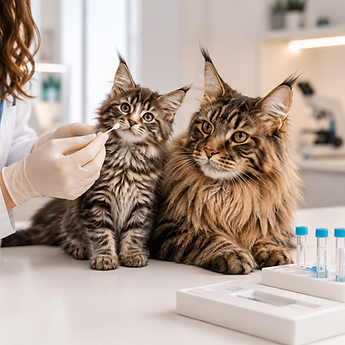
HCM DNA Testing: Why a Clear Result Is Not Enough
The Maine Coon HCM DNA test screens for a known mutation in the MYBPC3 gene. This mutation is associated with an increased risk of Hypertrophic Cardiomyopathy, commonly called HCM.
However, an N/N DNA result does not guarantee that a Maine Coon will never develop HCM.
The DNA test only checks for a known mutation. It cannot identify every possible genetic cause of HCM. PawPeds explains that some Maine Coons diagnosed with HCM through echocardiography or necropsy do not carry the known HCM1 mutation.
This is why responsible Maine Coon breeders still complete regular heart ultrasounds-Echocardiograms, even when their cats have clear HCM DNA results. DNA testing and echocardiograms are not interchangeable. They answer different questions.
SMA — Spinal Muscular Atrophy
SMA is an inherited neurological condition found in Maine Coons. Affected kittens may develop an unstable gait, posture abnormalities, and weakness in the hind limbs. Signs may begin at approximately three to four months of age. SMA is recessive. A cat with one copy is a carrier but is not affected. Two carriers bred together may produce affected kittens, so responsible breeders should avoid carrier-to-carrier pairings.
PKDef — Pyruvate Kinase Deficiency
PKDef is an inherited condition that may cause intermittent anemia. Affected cats may experience weakness, lethargy, weight loss, jaundice, or other symptoms related to anemia. The severity can vary from cat to cat. PKDef is also recessive. A carrier cat is not affected, but two carriers should not be bred together because that pairing may produce affected kittens.
Additional DNA Results Buyers May See
Many modern DNA panels include more than the three core Maine Coon tests.
These additional results do not always need to cause alarm. However, they should be understood, documented, and considered when making breeding decisions.
MDR1 Medication Sensitivity
MDR1 Medication Sensitivity, also known as the ABCB1 gene variant, affects how the body handles certain medications.
This variant has been identified in Maine Coons. Washington State University has specifically warned that cats with the MDR1 mutation may experience serious adverse reactions to products containing eprinomectin, an ingredient used in some parasite preventatives.
A cat with one or two copies of an MDR1 variant may still live a completely normal life. This is not something owners need to panic about. It is simply information that should be kept in the cat’s medical records. Before the cat receives medication, sedation, anesthesia, or parasite prevention, the owner should tell the veterinarian that the cat has an MDR1 variant. The veterinarian can then decide whether a different medication, dose, or product is more appropriate. A buyer who sees an MDR1 carrier result should not immediately assume that the cat is unhealthy. The important question is whether the breeder understands the result and communicates it clearly.
Factor XI Deficiency
Factor XI Deficiency, also called F11, is a clotting-related condition that has been identified in Maine Coons. A carrier with one copy is generally asymptomatic. A cat with two copies may have a slightly increased tendency to bleed, particularly after trauma or surgery. LABOKLIN notes that bruising and minor bleeding may occur in some affected cats after injury or a procedure. This is another result that should be documented and disclosed to the veterinarian before surgery. Breeders should avoid pairings that may produce affected kittens.
Factor XII Deficiency
Factor XII Deficiency, also called F12, is different from Factor XI Deficiency. Cats with Factor XII variants may show a prolonged PTT clotting time on bloodwork. However, affected cats have not been reported to experience abnormal bleeding.
In other words, the laboratory result may look unusual even though the cat does not actually have a bleeding problem.
LABOKLIN also notes that two different F12 variants have been described. A cat carrying both variants may need to be treated as affected because functional Factor XII protein may not be produced normally. Even cats with two affected copies can generally live normal lives and are not expected to have bleeding problems from Factor XII Deficiency alone. However, the result should still be documented, because another clotting disorder or medical condition occurring at the same time could affect the cat’s overall bleeding risk.
For a more detailed explanation, read our guide:
Factor XII Deficiency in Maine Coon Cats: Should Breeders Be Concerned?

Hip Dysplasia Screening: Why X-Rays Matter
Hip dysplasia is often associated with dogs, but cats can also be affected. Because Maine Coons are a large breed, hip structure should not be ignored. Hip dysplasia occurs when the hip joint does not fit together properly. Some cats may show visible discomfort or stiffness, while others hide pain surprisingly well. PawPeds recommends that Maine Coons be screened for hip dysplasia before they are used in a breeding program.
How Is Hip Screening Completed?
Hip screening is completed through properly positioned X-rays. For an official PawPeds result, the cat should generally be at least ten months old. X-rays taken before ten months may receive a preliminary result instead of a certified result.
The images should be positioned correctly so that the pelvis and hip joints can be evaluated fairly.
Does Every Breeder Need to Submit Hip X-Rays to OFA or PawPeds?
No.
OFA and PawPeds provide useful systems for standardized evaluation, public records, and long-term data collection. OFA accepts cats into its hip dysplasia, cardiac, and patellar luxation databases.
Submitting results can make it easier for buyers and other breeders to verify records. However, submission is not the only way to evaluate hips. Some experienced breeders maintain internal records and review properly positioned hip X-rays as part of their own breeding decisions. Some work with a veterinarian or radiologist without formally submitting every image to OFA or PawPeds. This does not automatically mean that the breeder is irresponsible.

HCM Echocardiograms: The Most Important Heart Screening
Hypertrophic Cardiomyopathy, commonly called HCM, is one of the most important health concerns in Maine Coons. HCM causes the walls of the heart muscle to become abnormally thickened, and some cats may appear completely healthy for years before changes become visible. An echocardiogram, also called a cardiac ultrasound or heart ultrasound, allows the veterinarian to evaluate the structure, movement, and thickness of the heart. Cornell University describes echocardiography as the gold standard for diagnosing HCM in cats. A routine veterinary exam is still important, but listening to the heart with a stethoscope is not the same as completing an echocardiogram.
The most important part of the report is the veterinarian’s written conclusion.
The report may classify the cat’s heart as:
-
Normal
-
Equivocal
-
HCM
-
Another finding that requires follow-up
“Equivocal” does not automatically mean that the cat has HCM. It means that the veterinarian noticed something that is not completely normal, but the finding is not enough to confirm HCM at that time. In some cases, an equivocal cat may remain stable. In other cases, the veterinarian may recommend another echocardiogram after six to twelve months.
Important Measurements on the Report
Buyers do not need to become cardiologists, but it helps to recognize a few common abbreviations:
-
IVSd: Thickness of the interventricular septum during diastole
-
LVFWd: Thickness of the left ventricular free wall during diastole
-
LA/Ao: Ratio between the size of the left atrium and the aorta
-
SAM: Systolic anterior motion of the mitral valve
For a simple buyer-friendly reference, the normal heart-wall thickness is often around 3–6 mm.
PawPeds explains that thickening above approximately 5 mm may lead to an equivocal or HCM assessment depending on the complete findings. Older studies used cutoffs closer to 5.5–6 mm, but current interpretation is more cautious.
This does not mean that buyers should diagnose a cat based on one number.
The veterinarian must consider the cat’s age, size, overall heart structure, localized thickening, papillary muscles, left atrial size, SAM, and other findings. The written conclusion from the veterinarian matters more than a single measurement.

What Should Buyers Ask a Maine Coon Breeder?
Maine Coon Kitten Buyers do not need to become veterinary experts.
However, asking a few simple questions can reveal a great deal about a breeder’s knowledge and transparency.
Ask:
Do both parents have DNA reports?
Which conditions were included in the DNA panel?
Do both parents have HCM echocardiogram reports?
When was the most recent heart ultrasound completed?
What did the veterinarian recommend for the next heart scan?
Were hip X-rays completed?
Can I review the parents’ records before purchasing a kitten?
A serious breeder should be able to explain the results in a clear and practical way. The breeder does not need to post every private medical record publicly. However, the records should exist and should be available to serious buyers.
Be cautious when a breeder only says:
“The parents are healthy.”
“The vet checked them.”
“The parents are HCM negative by DNA.”
“We have never had any problems.”
These statements are not the same as documented breed-specific health screening.
How Can New Maine Coon Breeders Find the Right Testing Providers?
New breeders often understand that health testing is important but still feel unsure about where to begin. DNA testing is relatively easy to arrange, while HCM echocardiograms and properly positioned hip X-rays may take more time to find.
Finding a DNA Testing Laboratory
For DNA testing, two commonly used options are Orivet and Wisdom Panel.
Both provide feline DNA testing reports that can help breeders review inherited health conditions and genetic traits. A useful report should clearly identify the cat, the testing date, the laboratory, the conditions included in the panel, and the cat’s individual result for each condition.
A broad DNA panel is a good starting point, but it cannot replace physical screening. A cat may have clear DNA results and still need regular HCM echocardiograms and hip X-rays.
Finding a Clinic for Hip X-Rays
Hip X-rays are usually easier to arrange than HCM screening. Many veterinary clinics can take X-rays, but it is still important to choose a clinic that understands proper feline hip positioning.
A poorly positioned image can make the hips difficult to evaluate fairly.
Clinics with experience submitting radiographs to organizations such as OFA or PawPeds are often a good choice because they are more likely to understand the positioning and image-quality requirements. However, formal submission is not required in every case. Some experienced breeders keep internal records and review the images with a veterinarian or radiologist.
When searching online, try using phrases such as:
-
cat hip dysplasia X-ray near me
-
feline hip dysplasia radiographs + your city or state
-
OFA hip X-ray clinic + your area
-
PawPeds hip X-ray cat + your area
-
breeder hip dysplasia X-ray clinic + your area
You can also ask local breeders where they take their cats for hip X-rays. Breeders who already complete health screening often know which clinics are familiar with the process. Before booking, ask whether the clinic has taken breeding-screening hip X-rays for cats before, whether digital images can be provided, and whether the clinic can submit the images to OFA or PawPeds if needed.
Finding an HCM Screening Provider
HCM screening can be more difficult to arrange because most general veterinary clinics do not offer breeding-screening echocardiograms.
For HCM screening, look for a veterinary cardiologist for breeding evaluations. The report should include measurements, a written conclusion, and a recommended follow-up schedule.
The easiest way to find a provider is often to ask breeders in your area. Local breeders usually know which cardiologists offer feline HCM screening and whether any lower-cost screening clinics are scheduled nearby.
PawPeds also maintains a list of veterinarians participating in its HCM Health Programme, which can be a helpful starting point.
If you still cannot find a provider, search Facebook for the group commonly called Global HCM Clinic. Breeders often use this group to ask about upcoming HCM screening clinics in their area. These clinics may be organized as screening events for breeding cats, which can make testing more accessible than booking a full cardiology appointment individually.

Health Testing Is More Than a Marketing Phrase
No breeder can guarantee that every kitten will remain free from every medical issue throughout its life.
That is not a realistic promise.
Responsible breeding is about reducing avoidable risks, keeping accurate records, understanding bloodlines, and making thoughtful decisions with the best information currently available.
DNA testing identifies known genetic variants. HCM echocardiograms evaluate the physical structure of the heart over time.
Hip X-rays provide information that cannot be found through DNA testing.
Optional screening, such as kidney ultrasound, may add another layer of caution depending on the cat’s history.
Instead of asking only:
“Are the parents health tested?”
Buyers should ask:
“Which tests were completed and may I review the reports?”
That question makes it much easier to recognize a knowledgeable and transparent Maine Coon breeder.
About LMCooNCat Maine Coons
LMCooNCat is a TICA- and CFA-registered Maine Coon cattery based in Southern California.
Since 2020, we have raised more than 200 Maine Coon kittens and have focused on health, temperament, structure, and long-term bloodline planning.
Our breeding cats receive DNA screening, HCM echocardiograms, and hip evaluations before they are included in our long-term breeding plans.
Health testing is only one part of the decision. Before a cat becomes part of our breeding program, we also watch long-term growth, structure, temperament, and family history.
Several cats behind our program have earned major show titles, including Lifetime Achievement, International Winner, Supreme Grand Champion, and CFA Grand Champion titles.
We believe that responsible breeding is not simply about producing beautiful kittens. It also requires transparency, continued learning, careful recordkeeping, and a willingness to make conservative decisions for future generations.

References
PawPeds HCM Health Programme
HCM screening recommendations for breeding cats, including timing for initial and follow-up echocardiograms.
https://www.pawpeds.com/cms/index.php/en/health-programmes/hcm/recommendations
PawPeds HCM DNA Test Information
Explains why the Maine Coon HCM DNA test does not replace echocardiogram screening.
https://www.pawpeds.com/cms/index.php/en/health-programmes/hcm/dnatest
UC Davis Veterinary Genetics Laboratory
Information on Maine Coon genetic testing, including HCM, SMA, and PKDef.
https://vgl.ucdavis.edu
PawPeds Hip Dysplasia Health Programme
Hip dysplasia screening and breeding recommendations for Maine Coons.
https://www.pawpeds.com/cms/index.php/en/health-programmes/hd/recommendations
OFA — Orthopedic Foundation for Animals
Health testing database information for cats, including hips, cardiac, and patella records.
https://ofa.org/about/faqs/
LABOKLIN Genetic Testing
Information on Factor XI and Factor XII deficiency testing in cats.
https://laboklin.com/en/products/genetics/hereditary-diseases/cat/
Frequently Asked Questions
Is DNA testing enough for a Maine Coon breeder?
No. DNA testing is an important starting point, but it does not replace HCM echocardiograms or hip X-rays. A Maine Coon can test negative for the known HCM mutation and still develop HCM from another cause.
Should a Maine Coon breeder complete heart ultrasounds-Echo?
Yes. HCM echocardiograms are one of the most important health screenings for breeding Maine Coons. A heart ultrasound evaluates the physical structure of the heart and can identify findings that DNA testing cannot detect.
Should Maine Coons receive hip X-rays?
Yes. Maine Coons are a large breed, and hip structure should be evaluated before a cat is included in a breeding program.
Is a Maine Coon with an MDR1 variant unhealthy?
Not necessarily. Maine Coon Cats with an MDR1 variant may still live normal lives. The result should be recorded and disclosed to the veterinarian before medications, sedation, anesthesia, or parasite preventatives are used.
Does Factor XII Deficiency cause abnormal bleeding?
Factor XII Deficiency may cause prolonged PTT clotting-time results on bloodwork. However, affected cats have not been reported to experience abnormal bleeding.
Should buyers ask to review the parents’ health reports?
Yes. Buyers should ask to review DNA reports, HCM echocardiogram records, and hip evaluation records for the parents of the kitten they are considering.
What health testing does LMCooNCat complete for breeding cats?
At LMCooNCat, our breeding cats receive DNA screening, HCM echocardiograms, and hip evaluations before they are included in our long-term breeding plans. Depending on the individual cat’s background and bloodline, we may also complete additional screening when appropriate.
Can buyers review the parents’ health records at LMCooNCat?
Yes. Serious buyers are welcome to ask about the parents’ DNA reports, HCM echocardiogram records, and hip evaluations. We believe that responsible breeding includes transparency and a willingness to explain what each result means.