Maine Coon Breeder Southern California


The White Maine Coons – California’s Only Cattery Still Breeding Whites
Edited by Ruoqi Lin.
September, 14 2025
In California, Maine Coons come in a wide variety of colors — from classic tabbies to smokes and silvers.
However, the white Maine Coon (Solid White Maine Coon) has always been one of the rarest and most highly desired colors.
Over time, fewer and fewer breeders have continued working with this unique color.
Many catteries in California that once carried white bloodlines have gradually stopped breeding for it altogether.
Today, we are the only cattery in California still consistently breeding white Maine Coons, committed to preserving and continuing this rare and precious bloodline.
For those who dream of owning a truly high-quality white Maine Coon, this may be the only place in California where that dream can come true.

Why The White Maine Coons Are So Rare / Few Breeders Work With Them
Maine Coons come in a wide variety of colors — classic tabby, smoke, silver, and many more.
Among these, white (Solid White) stands apart, giving a look of unmatched purity, elegance, and grace.
The pure white coat is caused by the dominant white gene (W gene).This gene completely masks the cat’s true underlying color, creating a flawless snow-white coat.
However, this masking trait also brings challenges: many breeders dislike working with the white gene because it hides what other color and pattern genes the cat carries, making pairing decisions and pedigree planning much more complex.

The White Maine Coons & Deafness – Our Health Promise
Many people worry that white Maine coon cats are more likely to be deaf. (Or you don't know)
In fact, this concern is closely related to the dominant white gene (W gene).
The dominant white gene creates a beautiful, snow-white coat, but it can also affect how the inner ear develops.
Hearing cells in a cat’s ears need pigment cells (melanocytes) to form correctly during development.
When there is a lack of these pigment cells inside the ear, the hearing pathway cannot fully develop, which may lead to congenital deafness.
Common Situations:
-
Two blue eyes → Highest chance of deafness, possibly affecting both ears
-
Odd eyes (one blue, one gold/green) → The ear on the blue-eyed side is more likely to be affected
-
No blue eyes → Significantly lower risk of deafness
How We Monitor Hearing
Starting when kittens are about 1 month old, we carefully observe and evaluate their hearing through daily interaction and behavior, including:
-
Whether they respond normally to sounds
-
If they can determine the direction of sounds
-
Any signs of hearing issues in everyday activities
-
Whether they react to noises while sleeping
These observations help us detect potential hearing problems at an early stage.
If a kitten shows any signs of hearing loss, we will clearly note and disclose this information to future owners.
This ensures that every family fully understands their kitten’s health before bringing them home.
Are Deaf White Maine Coon Kittens Really “Less Desirable”?
When people find out that a white kitten is deaf, they often hesitate, and their first reaction is usually to worry about whether this will affect the kitten’s quality of life. The truth is that deafness does not mean a kitten is unhealthy or unhappy. Deaf kittens can grow up to be just as playful, affectionate, and full of energy as any other cat. The difference is simply that they experience the world in another way, relying more on their sight, touch, and vibrations to understand their surroundings.
Caring for a deaf kitten is not as complicated as many imagine.
Owners only need to make small adjustments, like using hand signals, gentle touches, or floor vibrations to get the kitten’s attention. Over time, these methods become a natural part of daily life — not a burden — and often help build a stronger bond between the kitten and its family. Many people find that deaf kittens, because they depend more on their humans, form especially deep and trusting relationships.
Choosing a deaf kitten is not settling for less — it’s embracing a unique and special connection. These kittens are not defective; they are simply different. With patience, understanding, and love, they can bring joy, companionship, and an irreplaceable bond to your life, just like any other kitten — and often, even more.
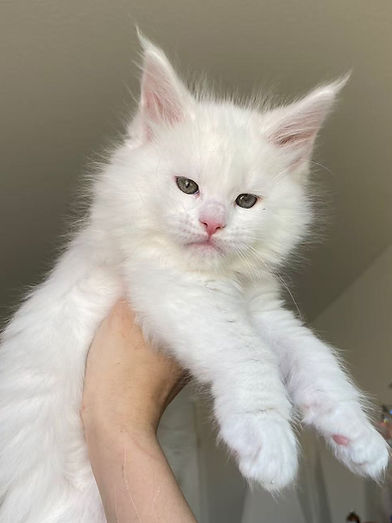
The “Head Cap” on White Maine Coon Kittens

Many people are surprised when they first see a white Maine Coon kitten and notice a small patch of gray or light-colored fur on the top of its head — almost like it’s wearing a tiny cap.
This little “head cap” is completely normal. It’s actually the kitten’s underlying coat color showing through because the dominant white gene (W gene) hasn’t fully covered it at birth. As the kitten grows, the white gene becomes more dominant, and this patch will gradually fade and completely disappear, usually by the time the kitten is 8 to 14 months old.
For breeders, the head cap can also provide clues about the kitten’s hidden color genetics, such as tabby, smoke, or red.
There’s no need to worry — this mark is only temporary. As the kitten matures, it will grow into a stunning, fully white Maine Coon, known for its majestic look and graceful beauty.
A Rare and Timeless Beauty
White Maine Coons are as unique as snowflakes — one of the most captivating and majestic colors in the Maine Coon breed.
Their stunning, elegant appearance combined with rare genetics makes them truly one of a kind.
Here in California, we are the only cattery still dedicated to breeding white Maine Coons,
preserving this rare color for families who dream of owning such a remarkable cat.
If you’re interested in bringing home a white Maine Coon,
click here to contact us and join our waitlist today.
Or, if you’d like to learn more about white Maine Coons,
click here to read more and start your journey toward finding your dream kitten.
