Maine Coon Breeder Southern California


Edited by Ruoqi Lin.
April 22, 2026
Why Do Seemingly Healthy Maine Coon Cats Still Develop HCM?
An In-Depth Look at Heart Disease Risks in Maine Coons
What Is HCM in Maine Coon Cats?
In Maine Coon cats, Hypertrophic Cardiomyopathy (HCM) is considered the most significant and commonly encountered cardiac condition within the breed.
From a medical standpoint, HCM is characterized by abnormal thickening of the left ventricular myocardium, often accompanied by impaired diastolic function. In some individuals, this may progress to left ventricular outflow tract obstruction, as well as secondary enlargement of the left atrium, both of which can compromise overall cardiac performance over time.
Unlike many other diseases, HCM in Maine Coons frequently presents without obvious clinical signs in its early stages. This means that a cat may appear physically robust, well-developed, and even in excellent show condition, while subtle structural changes in the heart are already present on imaging.
This contrast between outward health and underlying cardiac changes is precisely what makes HCM particularly deceptive and challenging to detect early.

Age of Onset and Hidden Nature
The age of onset for HCM in Maine Coon cats is highly variable. Clinically, cases can be observed as early as 6 months to 2 years of age, where early myocardial thickening is already present. At the same time, there are more typical cases that gradually develop between 3 to 14 years old, as well as late-onset cases that are only detected in senior cats.
This variability highlights that HCM is not a static condition, but a progressive disease over time. For this reason, a single normal cardiac screening does not guarantee lifelong safety in Maine Coons. This is also why repeated echocardiographic monitoring is strongly emphasized in responsible breeding programs.

Genetic Basis and Pedigree Complexity
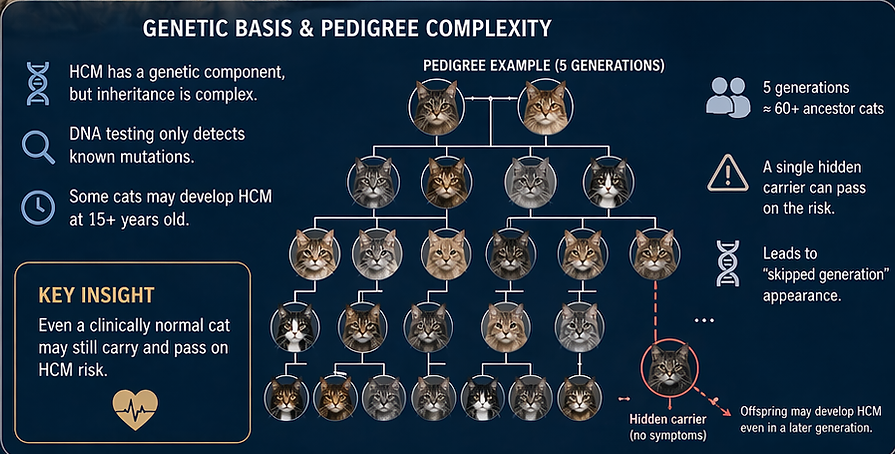
In Maine Coon cats, HCM has a well-established genetic component, but its mode of inheritance is not straightforward. Although specific mutations have been identified, current DNA testing only covers a portion of the known risk factors, meaning a negative result does not completely eliminate the possibility of disease.
From a pedigree perspective, tracing a Maine Coon back five generations involves more than 60 ancestor cats. Within such a complex genetic network, even a single carrier in the lineage may silently pass on the risk. This remains true even if that individual never showed clinical signs during its lifetime.
More importantly, HCM is often a late-onset disease. Some cats may not develop detectable changes until 15 years of age or later. While this may fall within a normal lifespan for a Maine Coon, if the cat has already been used in breeding prior to onset, the genetic risk may have already been transmitted. This is why HCM can appear to “skip generations” and re-emerge unexpectedly within a bloodline.
How to Scientifically Reduce HCM Risk in Maine Coon Cats
For Maine Coon Breeders - under current veterinary medicine, managing HCM in Maine Coon cats is more accurately described as risk control, rather than complete risk elimination.
The standard approach usually involves a combination of DNA testing and echocardiographic screening (heart ultrasound). Among these, echocardiography remains the most important tool, because it directly evaluates heart wall thickness, chamber size, and structural cardiac changes.
By comparison, DNA testing provides only genetic reference data. At present, only a limited number of HCM-associated mutations have been identified in cats, while the true genetic picture is believed to involve many additional genes and modifiers, potentially hundreds of pathways influencing disease expression. A negative DNA result should therefore never be interpreted as zero risk.
More importantly, these screenings must be performed repeatedly over time, not treated as a one-time clearance. In responsible breeding programs, periodic cardiac ultrasounds, for example every 18 months, provide a far more meaningful picture of long-term heart health.
For Maine Coons, time itself is part of the evaluation process. A bloodline that remains consistently clear through repeated monitoring carries far more value than a single normal result at one young age.
Nutritional and Metabolic Influences
Although HCM is fundamentally a genetic disease, nutritional balance and metabolic status can still play an important role in Maine Coon cats. Genetics may determine the underlying risk, but environmental factors can influence how strongly or how quickly that risk is expressed.
In recent years, veterinary cardiology has paid increasing attention to certain grain-free diets, particularly formulas that rely heavily on legumes, peas, lentils, or plant-based protein concentrates as major ingredients. In some cases, these diets have been associated with concerns regarding cardiac muscle health, nutrient bioavailability, or taurine metabolism. These findings were reported in a study released by the FDA in 2019.
FDA Investigation into Potential Link between Certain Diets and Canine Dilated Cardiomyopathy | FDA
In addition, high-sodium diets or long-term feeding patterns that create an unfavorable metabolic balance may place extra strain on the cardiovascular system. While these factors do not directly cause HCM, they may worsen existing predispositions or accelerate the progression of disease in genetically susceptible cats.
For this reason, nutrition in Maine Coons should not be viewed only as a tool for growth and coat quality. It is also an important part of long-term heart health management.

Screening Methods: The Limits of DNA Testing and Echocardiography
At present, evaluation of HCM risk in Maine Coon cats primarily relies on two tools: DNA testing and echocardiographic screening (heart ultrasound).
DNA testing is used to identify known mutations associated with HCM (Only two genes has been identified so far.). However, its limitation is clear: it cannot detect all possible disease-causing factors or future genetic discoveries. A normal DNA result should therefore be seen as helpful information, not a guarantee.
By contrast, echocardiography remains the most reliable clinical screening method available today, because it can directly assess heart muscle thickness, chamber dimensions, and structural cardiac changes in real time. This makes it especially valuable for detecting disease expression rather than only inherited risk.
However, even when both methods are used together, they can only reduce risk, not eliminate it entirely. This is an important reality that every responsible Maine Coon breeder, as well as families choosing a kitten, should clearly understand.
A Balanced Perspective: Don’t Let HCM Become a Source of Panic
At the same time, pet owners and breeders should not become overly anxious about HCM. In the cat world, across all breeds, there are many different health conditions that can occur. HCM is one of the more well-known ones in Maine Coons, but that does not mean every Maine Coon will develop it, or that it is the most common outcome.
The best approach is to stay calm, informed, and realistic. For pet families, that means learning how to choose a breeder carefully, asking about heart scans, health history, and whether the breeder continues to monitor their lines over time. For breeders, it means selecting breeding cats responsibly, based on health and long-term quality, not only looks or pedigree names.
At LMCoonCat, this is why we do not rely on DNA testing alone. DNA screening is helpful, but it cannot replace echocardiograms performed by a veterinarian or cardiologist. For our breeding cats, we use health screening as one part of our selection process before deciding whether a cat should stay in our program.
